ECO‑LUXURY, THE LUXURY OF THE EARTH
Luxury here is not marble or excess.
Luxury here is purity.
Solar energy warms the home.
Terracotta cools the rooms naturally.
Fresh filtered air flows through every space.
The pool is free of chlorine.
The garden grows with compost and care.
The eggs come from chickens raised under the sun.
The tortillas are made from blue organic corn grown by local farmers.
The fruits are harvested from nearby land.
This is a luxury that nourishes, heals, and respects the earth.
Casa Macondo is eco‑luxury in its purest form
a home where comfort and conscience live together.
THE FOOD RITUAL: “EL DESAYUNO MACONDO” (Included)
Breakfast at Casa Macondo is not a meal. It is a ritual.
Eggs with bright orange yolks from your own chickens. Tortillas made from blue organic corn. Local cheeses.
Papaya, pineapple, and exotic fruits grown in the region. Herbs from the garden. Coffee that tastes better because you drink it slowly.
This is food that comes from the earth, prepared with love, served with intention.
Families sit together, breathe the morning air, and begin the day with nourishment, not just for the body, but for the soul.
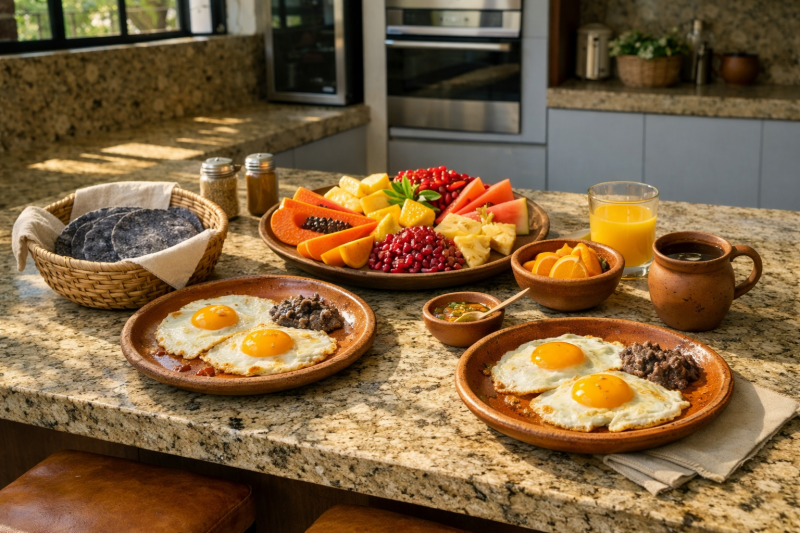

Native Blue Corn Tortillas
The blue corn of Mexico is an ancient grain cultivated for millennia by small local farmers who still honor the rhythm of the earth. Unlike industrial systems, this corn is grown artisanally and chemical‑free, with deep respect for biodiversity and the natural cycle of maturation. In Mexico, there is a strong commitment to avoiding glyphosate and genetically modified seeds, preserving the integrity of native varieties that have nourished communities for generations.
Its transformation into masa follows the traditional nixtamalization process, where the kernels are cooked with lime and allowed to rest and ferment naturally. This slow fermentation enhances flavor and texture while making nutrients more digestible and unlocking antioxidants and polyphenols unique to blue corn.
The result is a living dough, free of preservatives, pesticides, and industrial shortcuts, that respects both the body and the land. It is not the corn found in most of the United States, nor does it follow the same mechanized harvesting methods that interrupt natural ripening.
Mexican blue corn remains a food born from patience, fire, and heritage, a grain that carries the memory of the soil and the wisdom of time.

The Eggs of Casa Macondo
At Casa Macondo, our eggs are not just ingredients; they are the living expression of a small ecosystem in perfect balance. Our flock is led by King George, a proud Mexican Combatiente Malayo rooster, noble and vigilant, who guards his hens with the elegance and intensity of a true alpha protector. Around him roam five local hens, hardy, traditional Mexican breeds, who spend their days foraging freely, eating a diet intentionally low in corn and soy (and therefore low in PUFAs), complemented by vegetables, fruits, herbs, and the thousands of insects they hunt every afternoon. The result is not only healthier birds, but eggs with a structural integrity that surprises every guest who cooks with them for the first time.
What people notice immediately is how fast these eggs set in the pan. This is not imagination; it is the direct result of superior protein structure, nutrient density, and freshness.
1. Stronger Protein Matrix
Pasture‑raised hens produce albumen that is denser and more viscous. Because our hens eat fresh greens, insects, and whole foods, and because the eggs go from nest to pan in hours, not weeks, the proteins remain intact instead of breaking down into the watery consistency typical of supermarket eggs. In the kitchen: when whisked and heated with butter, these “strong” proteins form a tight network quickly, trapping moisture and creating a firm yet elastic curd.
2. Higher Solids, Less Water
Industrial eggs often contain more water in the whites. Studies show that organic, pasture‑raised eggs have slightly higher levels of proteins and lipids on a dry‑matter basis.
In the kitchen: with less water to evaporate, the egg reaches its coagulation point faster and with a cleaner, less slimy texture
3. Yolk Density and Natural Emulsion
A diet rich in greens and insects increases lecithin and beneficial fatty acids, including Omega‑3s, in the yolk. When cooked with butter: the yolk acts as a powerful emulsifier, creating a creamy, rich texture that still holds its shape beautifully as it sets.
4. The Power of Freshness
Freshly laid eggs have a lower pH, which keeps the proteins in a configuration that favors a stable, cohesive set. As eggs age, the pH rises and the proteins lose their ability to bind tightly, causing the egg to spread thinly in the pan.
Recommendation: cook them over very low heat. Because the protein structure is so efficient, they finish cooking with residual heat, remove them from the flame just before they look “done” for the perfect texture.